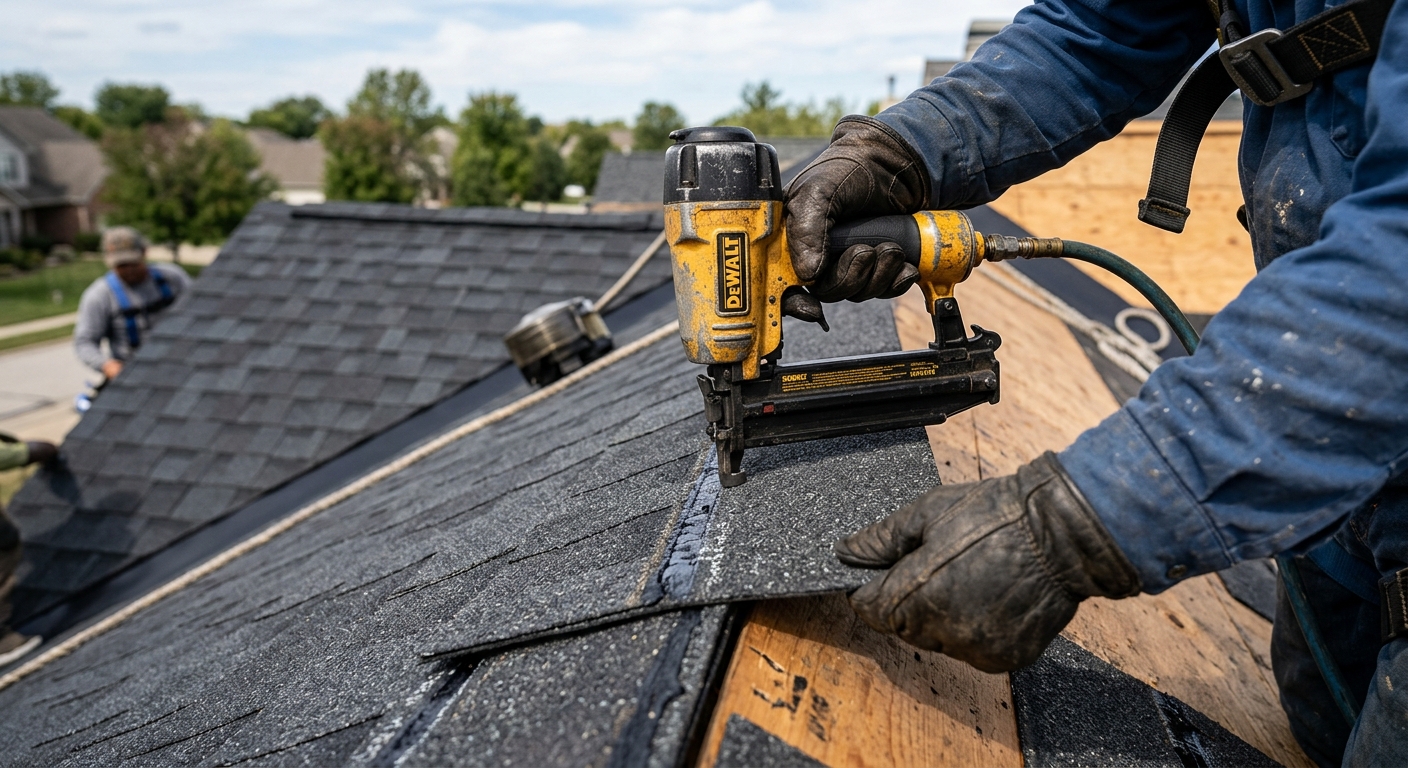
Waynesboro roofing prices by material and scope — 2026
In Waynesboro, the typical homeowner faces roofing costs shaped by the age and character of local homes: nearly half are owner-occupied, and a striking 71.9% were built before 1980 (U.S. Census Bureau, ACS 2024). This means roofs here have often lived out their original lifespan without ever being overlaid, so full tear-offs and deck inspections are common. The postwar building surge in Franklin County left many homes with a single layer of architectural shingles on stick-framed roofs—when these reach the end, replacement usually involves removing just one layer, but often reveals aging plywood or plank decks underneath.
Because so many houses in Waynesboro went up during the 1950–1980 period, waves of full roof replacements tend to hit entire streets at once, driving both demand and competition. As a result, the bulk of jobs involve mid-sized single-family homes rather than large custom projects or multi-layer tear-offs. These local realities make pricing here quite consistent, but travel surcharges sometimes show up south of Chambersburg due to Franklin County’s lower population density.
| Material / Scope |
Lifespan |
Best for |
Price range (installed) |
| Asphalt shingles — architectural (30-yr) |
25–30 yrs |
Standard Franklin County home |
$8,800–$18,500 |
| Asphalt shingles — impact-resistant (Class 4) |
30+ yrs |
Homes with wind or hail exposure |
$14,500–$18,500 |
| Metal standing seam |
40–70 yrs |
Low-maintenance or historic look |
$21,500–$38,000 |
| Flat roof — TPO or EPDM |
15–25 yrs |
Low-slope additions, garages |
$11,000–$22,500 |
| Roof repair — leak or isolated section |
n/a |
Small leaks, valley faults, flashing issues |
$475–$1,750 |
Prices are estimates for a typical Waynesboro home and vary with roof size, pitch, decking condition and material selection.
Reading a roofing estimate line by line
A Waynesboro roofing estimate worth trusting spells out the square footage (in "squares": each is 100 square feet) and names the actual pitch — these two numbers anchor every material and labor calculation. Watch for each layer being detailed: tear-off and dumpster, underlayment and ice barrier by brand or type, and a per-sheet cost for plywood replacement if hidden rot turns up. If the quote bundles these or uses vague terms like "roofing labor/materials," it’s impossible to compare properly or catch inflated figures.
Every estimate here should break out flashing, vent boots, and drip edge replacement, since homes built before 1980 differ in how these were originally installed. A proper warranty section lists the labor (workmanship) warranty separately from the manufacturer's shingle warranty—the former tells you if your installer will stand behind their work. Payment schedules should require no more than a 15% deposit, with the balance due only after work is finished and inspected. If any line is left blank or bundled as a lump sum, there’s nowhere to turn in case of later disputes—and you might find yourself paying for shortcuts or for work never done.
| Line item |
What to look for |
Red flag if… |
| Roof area |
stated in squares, with pitch |
no measurement given |
| Tear-off and disposal |
number of layers, dumpster included |
bundled into one figure |
| Underlayment |
product type and coverage |
listed only as 'felt' |
| Ice and water shield |
coverage height at eaves |
omitted entirely |
| Decking |
per-sheet contingency price |
no allowance at all |
| Warranty |
workmanship years stated separately |
only the shingle warranty |
| Payment |
deposit under 15%, balance on completion |
large upfront cash |
Checking out a roofer in Waynesboro: what to verify
In Waynesboro, you should never take a contractor’s word on paperwork. Pennsylvania requires every roofing company signing a contract over $500 to have Home Improvement Contractor (HIC) registration, which you can check directly at hic.attorneygeneral.gov. For any firm bringing employees on your property, active workers’ compensation is legally mandatory and can be confirmed through WCAIS (wcais.pa.gov). If your home was built before 1978, only use a contractor with federal EPA Lead RRP Rule certification—verify at certifiedrenovatorsearch.epa.gov. Always insist on a written contract as required by the Home Improvement Consumer Protection Act, and remember: you have a three-day cancellation right for contracts over $500.
- Verify HIC registration yourself at hic.attorneygeneral.gov
- Ask for a copy of workers’ compensation; confirm status at wcais.pa.gov
- Require EPA Lead RRP certification if your home predates 1978
- Confirm the contract includes scope, payment schedule, materials
- Ensure manufacturer warranty info is attached for all products
- Ask for references on similar homes or neighborhoods in Franklin County
- Get proof of liability insurance in writing
- Check local Franklin County property records for their recent jobs
- Demand a per-sheet plywood rate for hidden deck damage
- Decline offers to “waive your insurance deductible”—it’s illegal
- Be wary if the contractor can’t provide a local (814 or 717) phone/address
Red flags in this market: out-of-town crews with no local references, generic phone numbers without a known address, contractors unable or unwilling to show workers’ comp proof, and outfits asking for large deposits or full cash upfront. With Franklin County’s thinner rural demand, you’ll see travelling crews sometimes cutting corners—if in doubt, walk away.
What Waynesboro's housing stock means for your roof
If you own a home in Waynesboro, odds are good your roof was last replaced at least 25 years ago—over 70% of houses here were built before 1980, in a wave of postwar construction that dominates local subdivisions (U.S. Census Bureau, ACS 2024). These houses almost always feature moderate-pitch roofs framed with dimensional lumber, decked in either 1x6 planks or early plywood—meaning decking repairs are more common on the oldest structures, especially if there’s been a leak. Nearly all the original roofs were one layer of three-tab or architectural shingles, often still on their first replacement cycle. Because ice barrier underlayment wasn’t code-required when these homes were built, you won’t always find it up there now—if your eaves are shallow, you may need to invest in a few rolls of modern membrane.
Few roofs in Waynesboro have multiple layers; local building patterns favored one-and-done tear-offs rather than overlaying. This actually works in your favor when it’s time for replacement, as full deck inspections are easier and replacement costs are more predictable. Expect most quotes to include at least some decking replacement, especially if there’s any evidence of leaks or soft spots. The upshot: know what you’re paying for, and don’t skip the details—especially on a home built before the era of modern ice and water shield.
Timing a roof replacement in Waynesboro
In Waynesboro’s climate, your best roofing window runs from late March through late October, when the temperatures allow proper asphalt shingle bonding—these months reliably cross 50°F so new shingles set right. September is often the ideal time: crews aren’t yet backlogged ahead of storm season, and materials are less likely to be short after spring hail or wind claims. February and early March emergencies, on the other hand, price higher due to both labor scarcity and the extra care sealing shingles when daytime highs rarely clear freezing.
Franklin County sits on the edge of the Harrisburg–Carlisle market, with far fewer crews locally—meaning spring and fall fill up fast with planned jobs as postwar roofs hit end-of-life together. If you wait for a crisis in winter, expect a travel charge from outfits based north of Chambersburg or even higher bids from “storm chasers” with no Franklin County office. Planning even a month ahead often saves thousands, especially for full replacement work in the typical single-family neighborhoods here.
Roofing permits in Waynesboro: what you need before work starts
All roofing in Waynesboro falls under the Pennsylvania Uniform Construction Code (UCC), based on the IRC. The PA Department of Labor & Industry is the code authority, but here in Franklin County, enforcement falls to the individual municipalities unless they have opted out to the state. In the Borough of Chambersburg, replacing a roof triggers a building permit only if there are changes to structural sheathing or framing; swapping out shingles over an intact deck does not require a permit. In most unincorporated Franklin County townships, direct replacement of asphalt shingles without deck repair is performed without a permit.
Before hiring, make sure your roofer’s Home Improvement Contractor (HIC) registration is active—look it up at hic.attorneygeneral.gov. For jobs over $500, the law requires a written contract. Always verify the contractor’s workers’ compensation insurance via the WCAIS system at wcais.pa.gov. If your home was built before 1978, check that your contractor is EPA Lead RRP Rule certified at certifiedrenovatorsearch.epa.gov; this is a federal requirement, not just local policy.
If you’re still unsure whether you need a permit, contact either your township or the Borough of Chambersburg’s codes office directly—rules can shift even across short distances within Franklin County.
Snow load, ice dams and wind in Waynesboro
Waynesboro roofs are built for a ground snow load of 30 pounds per square foot and a winter design temperature of 12°F—both reflect the moderate but frequent snow and hard freeze cycles in south-central Pennsylvania. What makes Franklin County roofs different is their exposure to ridge-line winds funneled through the Cumberland Valley: gusts sweeping between South Mountain and the Blue Ridge routinely drive snow up under loose shingles and push water into valleys and corners. That’s why local roofers nearly always recommend ice and water barrier up past the eaves, even though many original (1950–1980) roofs never had it. This detail, which may add a few hundred dollars to the job, is cheap protection when you’re already investing $8,800–$18,500 in a new shingle roof.
Ice dams form here when attic warmth melts the underside of roof snow, which then runs down and refreezes at the cold eaves—blocking further drainage and backing up water under aged shingles. In older Waynesboro homes that never had eave membrane, this can force hidden leaks back through plank decking, ballooning what should have stayed a $475–$1,750 repair into a four-figure deck patch or partial tear-off. Hail is less common, but when it hits, it bruises shingles and accelerates granule loss—damage that’s hard to see but slices years off your roof’s life. Wind-driven rain also exploits missing or corroded valley metal, a vulnerability on every 1960s–1970s home still using the original flashing.
Frequently asked questions — roofing in Waynesboro
What is the best time of year to replace a roof in Waynesboro?
For Waynesboro homes, late spring through early fall—roughly April to October—is prime roofing season. Temperatures during this window allow proper sealing of asphalt shingles and fewer weather delays. If you book in September, before the October rush that hits as storms pick up in Franklin County, you’ll avoid both material shortages and labor bottlenecks typical for this area. Trying to replace a roof in mid-winter means your job might cost more, as crews are stretched thinner and heating takes extra time for each shingle to bond, especially with the 12°F winter design locally. If you can schedule outside of those emergency months, you’re likely to see prices settle closer to the median $14,500 for a quality architectural shingle replacement in Waynesboro.
Should I use a local roofer or a national company?
In Waynesboro, you’re almost always better off with a roofer who knows Franklin County. Local outfits are used to the single-layer tear-offs and stick-framed roofs built here between 1950 and 1980, and they’re familiar with the wind, snow, and permit wrinkles unique to this patch of Pennsylvania. National companies may have the brand power but often send crews unfamiliar with local nuances—and may add travel costs, or cut corners to get the job done quickly. Plus, a local contractor is easier to reach if a leak develops years after installation. Most reputable local roofers charge within the established price range—expect $8,800–$18,500 for a standard full replacement—without the inflated overhead of chain operations.
How much does a new roof cost in Waynesboro?
For a typical Waynesboro single-family home, a full replacement with architectural shingles in 2026 costs between $8,800–$18,500, with the average job landing around $14,500. If your roof needs special features—impact-resistant shingles for wind or hail, or extensive deck repairs—it may climb to the higher end of the range. Metal standing seam roofs, popular among homeowners looking for durability, generally cost between $21,500–$38,000. When comparing prices, always confirm what’s included: tear-off, disposal, underlayment, decking contingencies, flashing, and installation. Don’t settle for vague quotes—get every line item specified so you know exactly what you’re paying for.
How much snow load can a Waynesboro roof handle?
Roofs built in Waynesboro and throughout Franklin County are designed for a ground snow load of 30 pounds per square foot. That’s sufficient to handle the moderate to heavy snowfalls seen most winters in this region of Pennsylvania. This standard reflects local code and building practices, especially for homes constructed between 1950 and 1980. If your home is a classic single-family built before then and hasn’t had substantial structural work, it’s wise to confirm deck condition during replacement. If excess snow or drifting ever becomes an issue, a prompt mid-season snow removal may save you from repairs in the $475–$1,750 bracket.
What is the difference between TPO and EPDM?
Both TPO (thermoplastic polyolefin) and EPDM (ethylene propylene diene monomer) are membranes used for flat or low-slope roofs in Waynesboro. TPO is a white, heat-welded material that reflects sunlight, making it a solid pick for garage or porch additions where cooling may matter in the summer months. EPDM is a durable black rubber sheet—less reflective, but proven against ponding and freeze-thaw commonly seen in this part of Pennsylvania. Locally, either system generally costs $11,000–$22,500 for a full replacement, with TPO trending slightly higher due to installation technique and material cost. The biggest factor is the installer’s skill: an experienced crew is more important than the brand you pick.
What are the signs of hail damage on a roof?
In Franklin County, including Waynesboro, hail storms aren’t the most common hazard but when they hit, they leave behind bruises—dark or spongy marks where granules have been knocked off asphalt shingles. You won’t always see a hole or a crack; often, the shingle looks almost normal. However, bruises weaken the mat underneath and can cut years off your shingle’s lifespan, potentially turning a small repair in the $475–$1,750 range into a full tear-off at $8,800–$18,500 down the road if ignored. If in doubt, have a local roofer walk the roof and check recent losses—what seems minor from the ground may be severe enough for an insurance claim.
What does roof replacement cost per square in Waynesboro?
In Waynesboro, roof pricing is often quoted by the “square,” meaning 100 square feet of surface. For architectural asphalt shingles, you’re looking at $8,800–$18,500 total for an average home, which usually translates to about $440–$620 per square for a typical 30-square roof. The exact per-square number moves up if your roof is unusually steep, has multiple valleys or dormers, or needs lots of decking patching. Always ask whether the square count in your quote matches your actual roof area—not just the house footprint—so your comparison is apples-to-apples.
Is ice barrier underlayment required in Waynesboro?
In Waynesboro, under the Pennsylvania Uniform Construction Code (UCC), ice barrier underlayment at the eaves is generally required on new builds and major replacements, especially given the region’s history of ice damming and freeze-thaw cycles. However, many older homes built before 1980 never had it, as it wasn’t code at the time. Any reputable roofer will recommend adding an ice and water shield even if your existing roof doesn’t have one. Skipping this detail on a typical Franklin County job—especially at the eaves and valleys—might save a few hundred dollars in the short term, but it often results in leaks and decking repairs that cost much more than a basic $475–$1,750 fix.
How do I file a storm damage roof claim in Pennsylvania?
In Pennsylvania, including Waynesboro, if your roof is damaged in a storm, the first step is to document as much as possible—photos of the entire roof, close-ups of damaged shingles, siding, or gutters, and any evidence of leaks inside the house. Contact your home insurance company to report the claim and ask for a claim number. Most policies require you to prevent further damage, so temporary tarping by a local contractor (usually $475–$1,750) may be covered. Arrange for your insurer’s adjuster to meet with your chosen roofer on site; they can compare notes so nothing is missed. Never agree to a roofer “waiving your deductible”—it’s illegal in Pennsylvania and may void your claim. Always get everything in writing and keep receipts for all repairs.